Phase 2: Duplicating the Code
DNA Replication
The High-Fidelity Copy Machine of Life
Why This Matters
In bioinformatics, DNA is the master archival database, but a database is only useful if it can be copied accurately every time a cell divides.
Every human cell (except certain specialized cells) contains essentially the same genome. Before a cell divides, it must duplicate its entire DNA—about 3.2 billion base pairs—with extraordinary accuracy. This process is called DNA replication.
If replication fails:
- Mutations accumulate rapidly.
- Genes may become damaged or lost.
- Cells can malfunction or die.
- Cancer and many genetic diseases can arise.
- Sequencing data becomes harder to interpret because distinguishing true biological mutations from replication or sequencing errors becomes more challenging.
For bioinformatics, understanding replication explains why genomes remain remarkably stable over generations while still accumulating the rare mutations that drive evolution.
What Problem Does DNA Replication Solve?
Imagine a database server. When the server creates a backup, the backup must be almost identical to the original.
DNA replication performs exactly this task.
│
▼
DNA Replication
│
▼
Two Nearly Identical Genomes
Without replication, cells could never divide and organisms could never grow, repair tissues, or reproduce.
Where Does Replication Fit?
↓
DNA Replication
↓
Cell Division
↓
Growth, Repair, Reproduction, Evolution
DNA structure makes replication possible. Replication preserves the genome. Cell division distributes that genome to daughter cells.
1. The Replication Machinery
Copying the Database
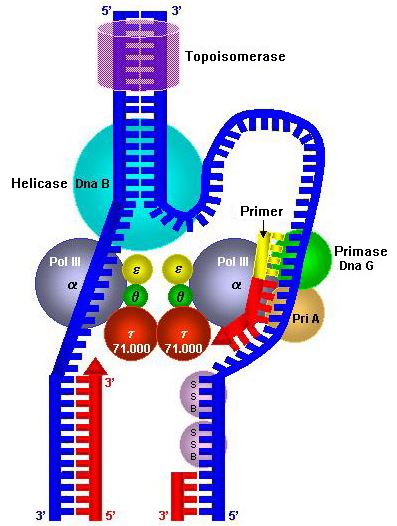
DNA replication is performed by a coordinated collection of proteins called the replication machinery or replisome. Think of it as a molecular factory. Different proteins each perform one specialized task.
| Protein | Job |
|---|---|
| Helicase | Opens the DNA double helix |
| Primase | Builds RNA primers |
| DNA Polymerase | Synthesizes new DNA |
| Ligase | Joins DNA fragments |
| Topoisomerase | Relieves twisting stress |
| Sliding Clamp | Holds polymerase onto DNA |
Every protein works together like an automated assembly line.
The Step-by-Step Process
The replication of DNA is highly coordinated and generally divided into three main stages:
1. Initiation
Replication begins at specific locations called origins of replication. Helicase unwinds the double helix, breaking the hydrogen bonds between base pairs, while Topoisomerase relieves the twisting tension ahead of the fork. Single-strand binding proteins (SSBs) coat the separated strands to keep them from snapping back together.
2. Elongation
Since DNA Polymerase needs an existing strand to add onto, Primase builds a short RNA primer. DNA Polymerase III (in prokaryotes) then takes over, sliding along the template strand and adding matching nucleotides (A-T, C-G) at blazing speeds (up to 1,000 bases per second).
3. Termination
When the polymerase reaches the end of the chromosome or meets another replication fork, the process terminates. The RNA primers are removed and replaced with DNA by DNA Polymerase I, and Ligase seals all the gaps in the backbone to create a continuous, unbroken double helix.

Semi-Conservative Replication
Each daughter DNA molecule contains:
- One original (parental) strand
- One newly synthesized strand
Old =======
Old =======
↓
Replication
Old ======= New
New ======= Old
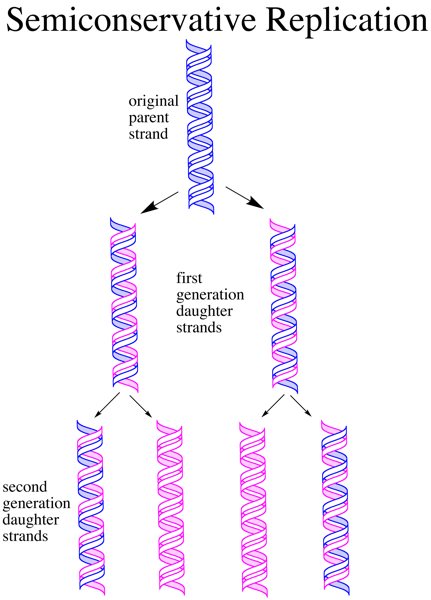
This is called semi-conservative replication. It preserves one copy of the original information in every daughter DNA molecule.
Bidirectional Replication
Replication begins at an origin of replication. From this origin, two replication forks move in opposite directions.
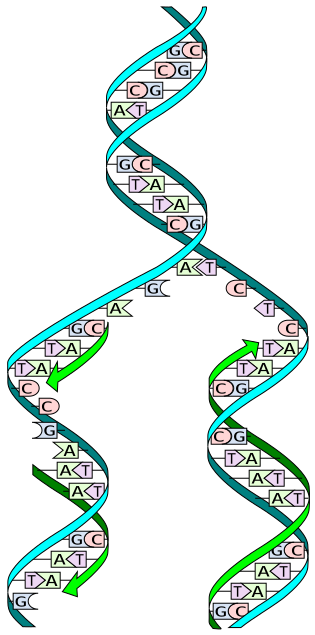
Instead of copying DNA in only one direction, cells copy both directions simultaneously, greatly increasing speed.
Why Two Strands Are a Challenge
DNA strands run in opposite directions. This opposite orientation is called antiparallel.
5' ------------------> 3'
Bottom strand
3' <------------------ 5'
The problem is that DNA polymerase can only synthesize DNA in the 5’ → 3’ direction. It cannot work backwards. This creates one of the biggest engineering challenges in molecular biology.
DNA Polymerase — The Copy Machine
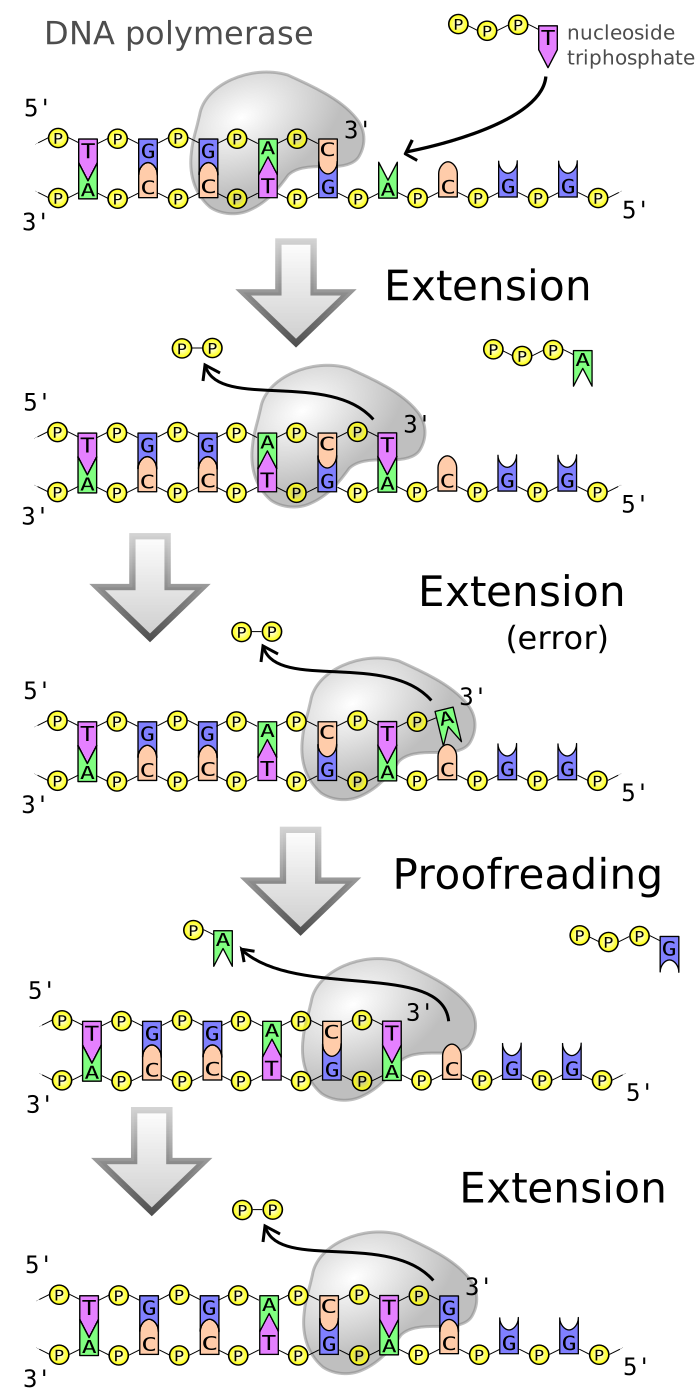
DNA polymerase is the enzyme that builds new DNA.
In Prokaryotes
- DNA Polymerase III performs most DNA synthesis.
In Eukaryotes
- DNA Polymerase ε (epsilon) copies the leading strand.
- DNA Polymerase δ (delta) copies the lagging strand.
All DNA polymerases:
- Read the template strand.
- Match complementary bases.
- Form phosphodiester bonds.
- Extend DNA only from a free 3’-OH group.
Think of DNA polymerase as a highly accurate molecular printer that can only print in one direction.
Why a Free 3’-OH Group?
DNA polymerase cannot begin synthesis from nothing. It needs an existing nucleotide with an exposed 3’-OH.
5' ---------3'OH
↓
New nucleotide attaches here
This is why another enzyme, primase, first creates a short RNA primer. DNA polymerase then extends that primer.
The Loop-and-Release Mechanism
The replisome copies both strands simultaneously. To accomplish this, the lagging strand bends into a temporary loop (the "Trombone Model").

──────────────→
Lagging Strand
↺ Loop
← Okazaki Fragment
As each fragment finishes:
- The loop releases.
- A new loop forms.
- Polymerase begins the next fragment.
This elegant coordination allows both polymerases to remain part of the same replication complex despite working on strands with opposite orientations.
Leading vs Lagging Strand
Because polymerase only works in the 5’ → 3’ direction, the two strands are copied differently.
Leading Strand
The template is oriented so polymerase can move continuously toward the replication fork.
====================
Continuous synthesis
Only one primer is needed. Replication proceeds smoothly.
Lagging Strand
The opposite template faces the wrong direction. Polymerase must repeatedly start over.
← Fragment 1
← Fragment 2
← Fragment 3
These short DNA pieces are called Okazaki fragments.
Each Okazaki fragment requires:
- A new RNA primer
- DNA polymerase extension
- Primer removal
- DNA ligase joining fragments together
Although the lagging strand is synthesized in pieces, the completed DNA is continuous.

Connection to Bioinformatics
Replication directly influences many computational analyses. Here is how replication concepts translate to bioinformatics applications:
| Replication Concept | Bioinformatics Application |
|---|---|
| Complementary strands | Read mapping |
| DNA polymerase fidelity | Variant calling |
| Replication errors | Mutation models |
| Bidirectional replication | Genome organization studies |
| Okazaki fragments | DNA replication research |
| Polymerase proofreading | Sequencing error interpretation |
When analyzing sequencing data, bioinformaticians constantly ask:
- Is this a real biological mutation?
- Or is it a sequencing machine error?
- Could it be an error introduced during PCR replication?
Understanding the molecular replication machinery provides the biological foundation needed to answer these questions accurately.
DNA Polymerase Fidelity → Variant Calling
DNA polymerases have a known "error rate" (e.g., 1 in 10 million bases). When bioinformatics tools perform Variant Calling to detect disease-causing SNPs (Single Nucleotide Polymorphisms), statistical models must distinguish true variants from these rare polymerase mistakes that occurred either naturally in the cell or artificially during library preparation (PCR amplification).
Complementarity → Read Mapping
Replication proves that one strand perfectly predicts the other. When a sequencer reads billions of short DNA fragments, Read Mapping algorithms leverage this complementarity to map those fragments back to a reference genome, testing alignments in both the forward and reverse-complement orientations.
Bidirectional Replication → Genome Organization
The physical constraints of bidirectional replication and multiple origins (in eukaryotes) influence gene location and evolution. Genes that are highly expressed are often located on the leading strand to prevent "collisions" between replication machinery and transcription machinery. Bioinformatics researchers analyze these genome organization patterns using statistical genomics.
If This Machinery Didn’t Exist
Without coordinated DNA replication:
- Cells could not duplicate their genomes.
- Cell division would stop.
- Growth and tissue repair would fail.
- Inheritance would be impossible.
- Genome stability would collapse.
- Comparative genomics and evolutionary analyses would lose the stable reference that makes them meaningful.